

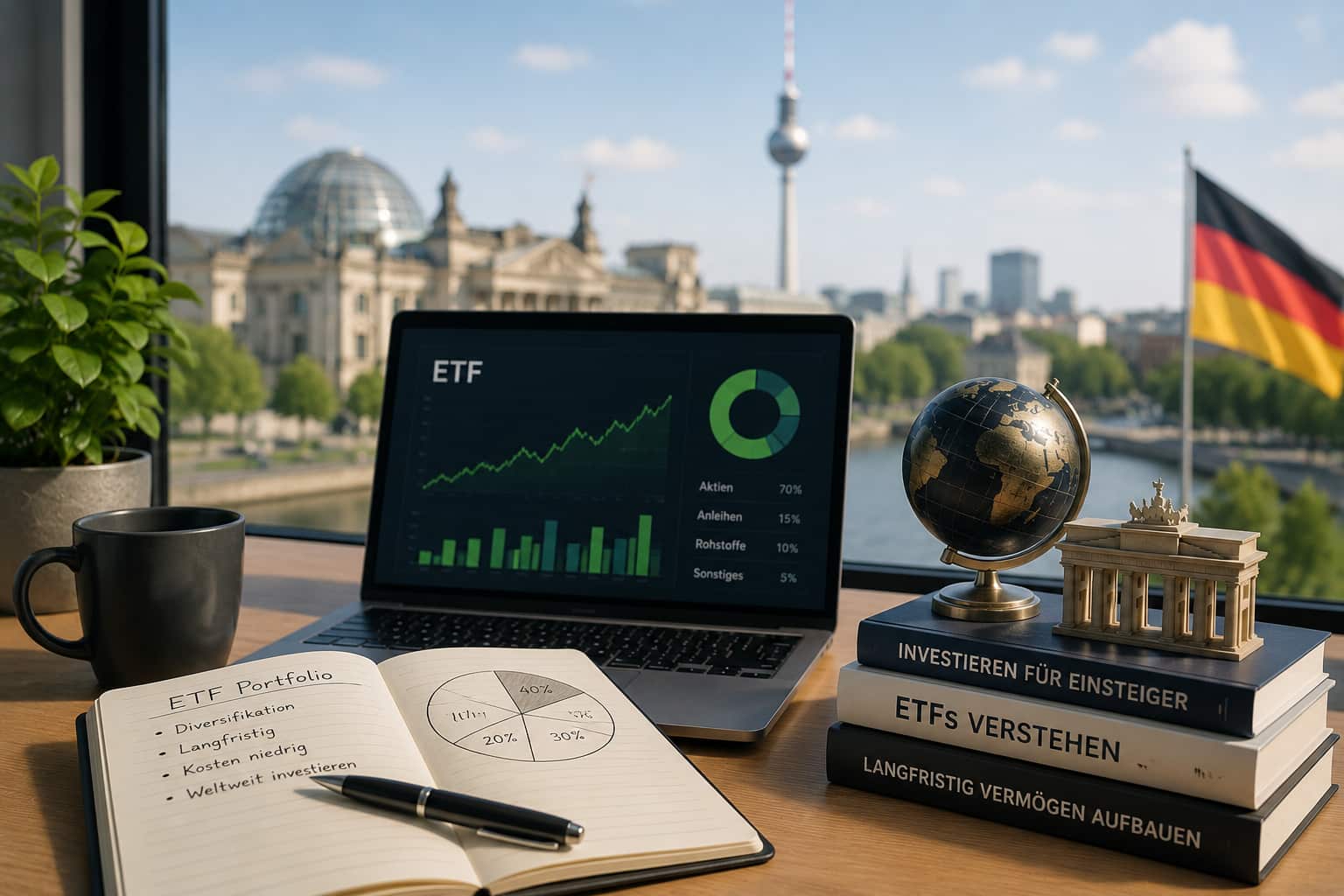
If you are just starting to learn about investing, you have probably already come across the term ETF. For many people, investing begins with ETF funds. They are mentioned in investing books, financial websites, and almost every discussion about long-term wealth building.
But what exactly is an ETF?
Simply put, an ETF allows you to invest in many companies through a single investment. Instead of buying shares of Apple, Microsoft, Siemens, Nestlé, and hundreds of other companies separately, you can buy one fund that already contains all of them.
That simplicity is one of the main reasons why ETF funds have become one of the most popular investment tools in the world.
Table of Contents
- What Does ETF Mean?
- How Does an ETF Work?
- Why Have ETFs Become So Popular?
- What Is Diversification?
- Types of ETFs
- ETF vs Individual Stocks
- Are ETFs Risk-Free?
- Who Are ETFs Suitable For?
- ETFs and Sparplan
- FAQ
What Does ETF Mean?
ETF stands for Exchange Traded Fund. While the name sounds technical, the concept is actually quite simple.
Imagine a basket filled with shares of many different companies. When you buy one ETF, you buy a small part of that basket.
The more companies included in the fund, the broader your diversification becomes. This is why many investors use ETFs as the foundation of their long-term investment portfolios.
Instead of choosing individual companies one by one, an ETF allows you to invest in an entire collection of companies through a single investment.
For many beginners, ETFs provide a straightforward way to participate in financial markets without needing to become experts in stock selection.
How Does an ETF Work?
Let’s say you want to invest in the global economy.
In theory, you could buy shares of hundreds of companies from different countries. In practice, this would be expensive, time-consuming, and difficult to manage.
An ETF solves this problem.
The fund provider creates a portfolio following specific rules, and investors can buy shares of that fund on the stock exchange just like regular stocks.
As a result, a single investment can provide exposure to hundreds or even thousands of companies.
For example, some global ETFs contain more than 1,000 companies from around the world. Building a portfolio like this individually would be difficult for most private investors.
Why Have ETFs Become So Popular?
The main reason is simplicity.
Most people do not want to spend hours analyzing company reports, following financial news, and selecting individual stocks.
ETFs offer a much easier alternative. Instead of trying to find the “best stock,” investors gain exposure to entire markets through a single investment.
ETFs are also popular because they offer:
- Broad diversification
- Low costs
- Transparency
- Easy access to global markets
- Long-term investing suitability
For many investors, ETFs become the first step into the world of investing.
What Is Diversification?
You have probably heard the phrase:
Don’t put all your eggs in one basket.
The same principle applies to investing.
If you invest only in one company, your results depend entirely on that company’s success or failure.
When your money is spread across hundreds or thousands of companies, the impact of any single company becomes much smaller.
This approach is called diversification.
While diversification cannot eliminate all risks, it helps reduce dependence on individual companies, industries, or countries.
For this reason, diversification is considered one of the most important principles of long-term investing.
Types of ETFs
Today there are thousands of ETFs available.
They can focus on:
- Global stock markets
- U.S. companies
- European companies
- Bonds
- Specific industries
- Commodities such as gold
- Emerging markets
For beginners, broadly diversified ETFs are often the most popular choice.
One of the best-known examples is the MSCI World Index.
You can learn more in our guide: MSCI World for Beginners.
ETF vs Individual Stocks
When you buy a stock, you are investing in one specific company.
If that company performs well, the stock price may increase. If the company struggles, the value may decline.
With an ETF, your investment is spread across many companies.
As a result, the performance of a single company has a much smaller impact on your overall investment.
This is one of the main reasons why many beginner investors start with ETFs rather than individual stocks.
Are ETFs Risk-Free?
No.
Although ETFs are often considered safer than investing in individual stocks, they are not risk-free.
If an ETF invests in stocks, its value can rise and fall along with the market.
During economic crises or market downturns, ETF prices may decline temporarily.
Diversification helps reduce certain risks, but it cannot eliminate market risk completely.
All investments involve risk, and ETFs are no exception.
ETF funds reduce some risks through diversification, but they cannot eliminate the risk of market fluctuations.
Who Are ETFs Suitable For?
ETFs are often chosen by people who:
- Want to invest for the long term
- Prefer a simple investing strategy
- Do not want to analyze individual companies regularly
- Want broad diversification
- Use monthly investment plans such as Sparplan
For many investors, ETFs provide an easy and practical way to start investing.
ETFs and Sparplan
In Germany, many investors buy ETFs through a Sparplan.
A Sparplan is an automatic investment plan where your broker invests a fixed amount of money into a selected ETF every month.
This approach helps build investing discipline and removes the need to decide manually when to invest.
Many investors start with monthly contributions of €25, €50, or €100 and gradually increase them over time.
Read more: What Is a Sparplan?
Final Thoughts
An ETF is an investment fund that allows you to gain exposure to many companies or assets through a single investment.
Because of their simplicity, diversification, and convenience, ETFs have become one of the most popular long-term investment tools worldwide.
For many people, investing starts with ETFs and regular monthly investing through a Sparplan.
FAQ
What is an ETF in simple terms?
An ETF is a fund that already contains many companies or other assets. By buying one ETF, an investor gains access to a diversified collection of investments.
Can I lose money with ETFs?
Yes. ETF prices can rise and fall together with the market.
What is the difference between an ETF and a stock?
A stock represents ownership in one company. An ETF usually contains many companies within a single fund.
How much money do I need to start investing in ETFs?
Many Sparplans in Germany allow investors to start with as little as €25–50 per month.
Which ETF is best for beginners?
Many beginner investors start with globally diversified ETFs that invest in a large number of companies around the world.
What to Read Next
- How to Start Investing in Germany
- MSCI World for Beginners
- What Is a Sparplan?
- How to Choose an ETF
- Accumulating vs Distributing ETF
- Best Brokers in Germany
- ETF Taxes in Germany
Want to Learn More About Investing in Germany?
In the Finditerra Telegram community, we regularly share beginner-friendly investing guides, ETF explanations, insights about investing in Germany, and practical ideas for long-term wealth building.
Whether you are just getting started or want to better understand ETFs, taxes, brokers, and financial planning in Germany, our content is designed to make investing easier to understand.
- ETF and investing guides
- Financial education for expats in Germany
- Broker and tax explanations
- Long-term investing strategies
- Regular educational content